Saturday, October 27, 2007

The Ring

(2002) *****

Two teenaged girls are home watching TV. One tells the other about a rumor going around, about a videotape that when watched somehow causes the death of the watcher a week later. As it turns out, the second girl (Katie) had seen the tape a week prior, and after faking distress to tease her friend, ends up dead a few moments later. The friend is sufficiently traumatized by what she witnessed that she ends up in a psychiatric hospital. Katie's aunt is an investigative reporter and sets out to find out about Katie's death and the mysterious tape. As her investigation develops, a disturbing family tragedy is revealed.

The truth? This PG-13 movie is still one of the creepiest I've ever seen. I had seen it the year it came out but not since. This time around, of course I had to watch it home alone on a rainy, windy night, and I experienced a delicious sense of dread for much of the movie. My palms were damp at the end (I proactively called husband as the credits began to roll, to make sure the phone didn't ring just then). Why was I so creeped out? If you've seen it, you know why; if not, go rent it immediately!

Friday, October 26, 2007

Blacula


(1972) ***1/2

As I waited for Running Freak near the aid station during her freakishly long 50 mile trail run, I had one of those moments of enormous perspective. It’s a flawless, sunny day. I’m sitting on a hillside with a breathtaking view of San Francisco (is there any other kind?) and I’m watching a pristine, digitally remastered version of Blacula on my IPOD. I love the human race and everything we’ve accomplished. Dolphins? Pfft. Intelligent, my ass.

I’ve always been curious about Blacula but never felt comfortable renting it as common sense dictates that everything about it is so very, very offensive. Now that I no longer get offended by anything (aside from the occasional condescending mock Barnie review), I decided that it was time to give it a proper looksie.

One hundred and fifty years ago, Count Dracula has Prince Mamuwalde and his wife over for dinner. Some grossly inappropriate comments defending slavery reveal that in addition to being a remorseless killer, Dracula was also a racist ass. Disgusted with the distasteful words, Mamuwalde gets his coat only to be confronted by a group of thugs. After a brief torch fight, Dracula bites him the neck and declares “I shall curse you! You will become Blacula!” Cue the funky awesome theme music.

Next we’re introduced to an interracial gay couple vacationing in present day Transylvania. They purchase a host of Dracula memorabilia including a coffin. When they open the coffin back in the states, Blacula pops out and immediately has a bite. A quick flashback voiceover repeats “I shall curse you! You will become Blacula!” The reminder was a nice gesture and but entirely unnecessary as Blacula is the title of the movie and those words were spoken less than 5 minutes ago.

Blacula becomes a respected member of the community and falls in love with Tina, a woman who has a striking resemblance to his deceased wife. (It was the same actress.) They make sweet, tender love and he soon shares his dark secret with her. While his reign of terror continues to create more and more vampires, he loves Tina too much to drink her blood. Awwww. Tina then has to decide what is more important – the fate of mankind or her sexy, powerful yet soft and gentle vampire lover man.

Blacula goes down smooth, like the cold beer that was in my hand as I viewed it. 1970’s Blaxploitation films are often criticized for conforming to racial stereotypes but compared to say, a 3 minute 50 Cent video, this movie is about as offensive as a Partridge Family episode. (If anything, it’s insulting to the gay community.) Also, despite the campy sounding title, this is not a comedy by any means. It deserves to be taken as seriously as any other 70’s vampire movie.

Strait-Jacket

(1964) ****


Joan Crawford had complete control over the script, casting and well, everything in this Lizzie Borden inspired classic. And why shouldn’t she? She put forth an outstanding performance in a modest budget horror film about an ax murderer.

Fresh from a 20 year stint in an insane asylum for beheading her husband and his mistress in front of her daughter, Lucy Harbin tries to pick up the pieces. She moves in with her daughter Carol, who has amazingly grown up to be a caring, well adjusted young woman. To help smooth the transition and make up for lost years, Carol takes Lucy shopping and gives her a makeover. For a brief period, it looks like she’s able to move on with her life.

Then she starts to lose it… Determined to turn back the clock, Lucy refuses to acknowledge her age and inappropriately flirts with her daughter’s fiancĂ©e. When Carol's potential in-laws won’t give their blessings stating she’s not good enough for their son, the heads begin to roll.

Crawford proves why she’s one of the greats by putting everything she had into this role, and almost certainly drawing from her personal life. By the end of this brief film, Lucy Hardin feels like a life-long acquaintance. She’s strong willed, petty, self obsessed but also deeply sad and always merely fractions away from insanity. Though miles away from the perfection of Psycho, Strait-Jacket is still a standout.

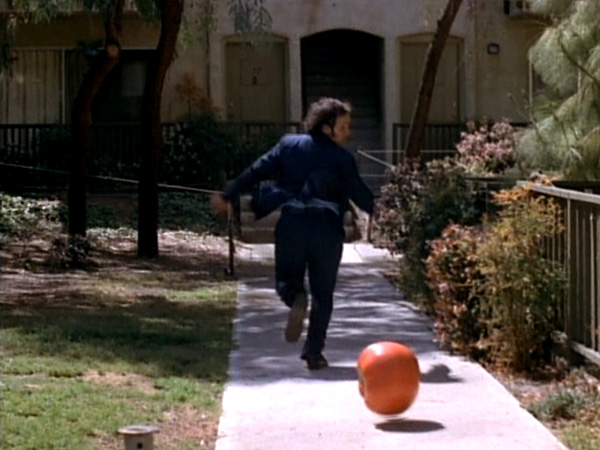
Attack of the Killer Tomatoes

(1978) **

"Hey, can somebody please pass the ketchup?"

In a takeoff of 50s horror movies, mutant tomatoes are attacking and killing citizens in the USA. The government takes action, but will it be enough? And who is behind the these attacks, anyway?

I was disappointed that Killer Tomatoes is NOT the worst movie ever made. Sure, it's not scary at all, but I had several chuckles, and I've seen many worse movies in my life. It has lots of little jokes and sight gags, kind of like a not-very-good "Airplane." I fell asleep watching it twice but was finally able to finish the sucker last night. Ironically, my DVD player has eaten this DVD- it is jammed in there good and tight, so one way or another watching this movie is gonna cost me. Horrific as that is, it still isn't the worst movie ever.

Sweeney Todd


(Boston, 2007) ****1/2

London, Victorian era. We are introduced to Sweeney Todd, a barber with terrible losses in his life, almost too much for him to bear. He has returned to London under an alias seeking revenge. He is taken in by Mrs. Lovett, a middle-aged woman with an agenda of her own when it comes to Mr. Todd. Mrs. Lovett happens to sell “the worst meat pies in London.” When the barber is recognized by a rival and an attempt is made to blackmail him, Todd eliminates the possible threat using his straight razor, and the pragmatic Mrs. Lovett discovers a way to improve the freshness and quality of the meat she uses to bake her pies.

Yes, it’s the Stephen Sondheim musical I saw live last night, so no it doesn’t count. But the show was tragic and bloody and funny and extremely well done. The body count is really high. We get a real sense of how the unutterable tragedies have pushed Sweeney Todd to this point. This production has each actor playing different instruments- the actors were the orchestra- which was both impressive and effective. The set was simple- chairs, a coffin, a cabinet, and a ladder on an otherwise bare stage. The music is fabulous and the actors were wonderful.

This is a musical even people who hate musicals could love.

The Monster Squad


(1987) **1/2

The monster squad is a group of 12-year olds who spend their days talking about horror movies and debating various horror trivia. What a bunch of losers, huh? They meet in one of those tree houses that only exist in the movies. You know, it’s supposed to look slapped together but it’s incredibly huge, sturdy, nicely decorated and has electricity. My treehouse consisted of exactly 3 boards and often fell down when I sat on it. It kind of resembled this beauty,

Anyway, a number of events coalesce suggesting that the “real” monsters are congregating in the squad’s small town. Luckily, monster squad leader Sean recently found Van Helsing’s diary, which describes an ancient amulet composed of “conentrated good”. The diary further reveals that each century the amulet becomes vulnerable to destruction for one day as the forces of good an evil become balanced. Huh? Coincidentally this day of balance will be occuring in 48 hours. Okay, stay with me here. The monster squad conclude that it is necessary to acquire the amulet and read an incantation from Van Helsing’s diary, which would have the effect of creating a portal in the sky, casting the monsters into Limbo. I need a break.


The only problem is that the amulet is located in a secret room under the house where the monsters are meeting. Fortunately for the monster squad, the room is protected with numerous holy symbols and junk, preventing Dracula and gang from easily taking it. Will the monster squad be able to break into the monsters’ home, grab the amulet, and send the monsters back to hell before it’s too late? Go see Monster Squad.

Like Van Helsing (2004), Monster Squad is an earlier example of squandered opportunity. Creating a good story with the classic Universal monsters should be a no-brainer. It would be like gaining the rights to use Jason Voorhees, Michael Myers, Freddy Kruger, and Pinhead. Instead, the “monsters” in Monster Squad are watered down, neutered threats with Frankenstien presented as a comedic character. Granted this is a kids' movie, but there should be some respect for these old characters and some attempts to maintian their integrity. There is nothing scary about them and surprisingly they receive little screen time. When the Gillman briefly pops out of a sewer he is immidately shot and killed. The Wolf Man and Mummy have exactly one good scene near the end of the film. I mean, shit, if I had access to these classic monsters I’ve have them in every goddamn scene even if they’re just standing around the water cooler..

It’s interesting to watch films from the 1980s compared to today. It's clear that the ratings system was murkier in terms of acceptable content. While the “scares” are tame the language is, at times, quite adult. For example, in this scene Dracula says to this little girl,

“You little BITCH!”

In another scene one of the boys sarcastically remarks that his teenage sister lets all the guys, “squeeze her tits” (!) Later, after realizing that a virgin is needed to read an anti-monster incantation, the same boy repeatedly asks her sister if she is a virgin. Hesitating she claims that she is but notes, "Well, Steve but he doesn't count." (!) This is a film made for the Goonies crowd for crying out loud. It’s also funny how non-PC the film beocmes at times. For example, one of the monster squad members, a fat kid, is referred to as “fat kid” throughout the film!

Monster Squad disappoints on all levels. It’s not funny, it’s not scary, the FX are terrible, the action is lame, and there’s nary a boob. Oh right, kids’ movie.

Fat kid

Oh yeah, and this annoying kid is in it

Thursday, October 25, 2007

The Hitcher (remake)

(2007) **

JPX is not alone in his disappointment of The Hitcher. The characters were boring, and the film was predictable, with barely a hint of excitement or creativity to compensate for this. There was, however, one scene that did stick out to me. After, as JPX nicely put it, the “horror-movie-cinematic-every-couple,” have escaped the hitcher and awoken from their nap, they hit the road again to discover the creepy hitcher riding in the back of a station wagon with a Jesus loving family. The viewer knows this because their car is sporting a bumper sticker that says, “Honk if You Love Jesus.” Unfortunately, Jesus couldn’t save them, and the husband, wife, and two young kids are brutally murdered by the hitcher. The husband does however live long enough to pray. It is that very fast paced, repetitive praying, that brings that five letter word to mind, “crazy.”
I couldn’t help but wonder about the point that is being made? The thought has to cross your mind that how can someone still maintain his or her religious devotion after his or her family has been viciously murdered? How can a person undoubtedly maintain his or her faith when his or her children have been slaughtered? What kind of God allows children to be slain? If such calamity can strike upon a decent Jesus loving family, then what does that mean for the rest of the world?

Is this films message that not even Jesus can protect you from the world’s darkness? Or is it, that the bonds of religious devotion are so strong that not even tragedy can break them?

El Espejo de la Bruja (The Witch’s Mirror)

(1962, Mexican) ***1/2


Thematically similar to Les Yeux Sans Visage (which is probably why Netflix practically begged me to check it out), The Witch’s Mirror tosses witchcraft and mad science into the mix with interesting results.

After foreseeing the murder of her goddaughter at the hands of her husband, a witch named Sara prays to Lucifer for assistance. The Devil hears her prayers but explains that Elena’s death is predestined and cannot be prevented. Elena accepts her fate and bravely (or stupidly) drinks the poison drink that Eduardo puts in her hands. Sara vows revenge.

Eduardo marries his former mistress and unknowingly hires the scheming godmother as their maid. His new wife Deborah is very moody, manipulative and condescending. She instructs Sara to remove all traces of Elena from the home. Sara obliges, but simultaneously summons Elena’s ghost through a totally cool magic mirror. After a thorough house haunting, Elena gets her vengeance by horribly disfiguring Deborah with a fire.

Surprisingly, Eduardo proves his love for Deborah by standing by her side and vowing to make her beautiful again. (He also happens to be a doctor.) With the assistance of handyman Gustavo, he steals bodies from the morgue to use for the skin graft operations. When corpse-napping doesn’t suffice, he moves on to murder. All of this serves only to fuel Sara’s rage. She spends the remainder of the film going through great lengths to prove that pissing off a witch is a terrible idea.

I enjoyed the fact that there are no purely good or purely evil characters. Eduardo is a murderer and bastard yet he is wholly devoted to Deborah. Sara’s vengeful behavior stems from her love for Elena and the unjustness of her death. Elena dies an innocent victim but her spirit takes part in the diabolical plans. And Deborah could be accurately described as a total bitch but she was not involved in any criminal activity and her suffering is therefore unjustified.

It also boasted delightfully eerie sets and music. The scenes involving witchcraft were executed with great care and prove to be a cut above most of its 1950's American counterparts.

Zombies of Mora Tau

(1957) **1/2


Also taken from the recently released Sam Katzman collection, this one is noteworthy because the zombies differ from both the voodoo slaves of yore (White Zombie, Revolt of the Zombies) and the flesh eaters that we all know and love today.

It begins with a hit and run on an isolated road near the coast of Africa. Jeff the passenger is appalled that his driver left the body on the side of the road but she calmly explains “he wasn’t a man, he was one of them."

Flash back to 1894 when an expedition of ten explorers raided a native temple and stole precious diamonds. By the time they returned to their ship, a curse transformed them into mindless zombies. They attacked their shipmates and sank the ship and treasure to the bottom of the sea. In the 60+ years since, the zombies have remained in the water to protect the diamonds from anyone foolish enough to search for them. A cranky old bitty named Mrs. Peters explains all of this to the latest bunch of diamond seekers. This group remains undeterred despite seeing the graves of past intruders as well as freshly dug graves ready to receive their own bodies. Some people just need to learn things the hard way.

I love the concept of the underwater zombie and would pay to see more of them. (The only other one I can think of is the zombie that took a bite out of a shark in Fulci’s Zombi 2.) Though Zombies of Mora Tau is generally considered to be an overachiever, the zombies guarding a sunken ship concept would have been infinitely more exciting had they been able to afford underwater cameras. The lack of a budget forced them to crawl out of the water and pull their victims into the sea.

There's no good reason to go out of your way to see this movie but if you stumble into it, there's no need to panic.

Motel Hell

(1980) ***


If you’re in the mood for an old fashioned B-movie romp you could do much worse than Motel Hell. I previously underrated it ** but I’ll admit that even Johnny Sweatpants can occasionally get it wrong. Or perhaps my standards have lowered.

The plot is so simple that it’s almost clever. Just how does Farmer Vincent make the best damn burgers in the whole damn world? By using people of course! Assisted by his twisted sister Ida, he rounds up victims and plants them in his garden, allowing only their heads exposure. To prevent the poor saps from screaming for help, he cuts their vocal chords out. This causes them to make gross, gurgling noises that are unsettling if watched while sipping your morning coffee. When they feel one is “ripe”, they pull him out of the ground, kill and cook him.

That’s it. Vincent’s motivation is nothing more than receiving compliments on his burgers. It rarely occurs to him that there may be something immoral about murder and cannibalism but he roundly dismisses such thoughts with sayings like “there’s too many people and not enough food” or the even catchier “meat’s meat and a man’s gotta eat”.

Motel Hell is played straight for the most part but it does sometimes revel in its own inadequacies. Its ideal setting is at the drive in on a Saturday night with a full moon and an even fuller cooler of beer and maybe some sandwiches.

Night of the Living Dead


They're coming to get you, Barbara!

1968 (*****)

How can a movie this bad be this good? The last two entries in my "Masterpiece Series" (Alien, The Exorcist) are premier examples of big-budget, Oscar-winning, meticulous Hollywood artistry and craftsmanship with A-list actors, groundbreaking special effects and some of the most renowned and accomplished photography, sound and technical innovation ever applied to filmmaking. Night of the Living Dead (1968)—made independently in black and white with looped mono sound for $114,000 (from a script written in three days), starring mediocre non-actors (including one of the producers in a major speaking role) who ad-libbed their dialogue, shot almost entirely in a borrowed Pennsylvania farmhouse, and scored with stock music cues from Capital Records' library—was chosen by the Library of Congress to be entered into the United States National Film Registry due to its "historical, cultural and aesthetic importance" and selected by New York's Museum of Modern Art for inclusion in its permanent film collection.


After this most recent viewing (and after dwelling on Hitchcock's vastly superior black-and-white compositions in Psycho) I'm forced to admit that Night of the Living Dead has production values so low that it would not be out of place to see robot silhouettes in the lower right corner of the screen. None of the actors has any skill, and the filmmakers don't seem to own a tripod, let alone a crane or a dolly. There is no source sound. A modern viewing is further hampered by obscure copyright issues: since the movie is in the public domain, it's practically impossible to see a legitimate 35mm screening; nearly every home video copy is reproduced from inferior 16mm dupes, and only one of the several DVD editions is a legitimate digital transfer from the original full-size answer print. It's not the definitive zombie movie (or even the definitive George A. Romero zombie movie); those honors belong to the subsequent, vastly more ambitious Dawn of the Dead (1978), in which Romero himself does this movie the ultimate "sequel/follow-up" indignity of pretending it never happened.


And yet...and yet. Despite shortcomings that would seemingly cripple or destroy any movie, Night of the Living Dead remains brilliant, timeless; a masterpiece of the first order. Even when so badly reproduced, the visuals have a raw, documentary simplicity that borders on lyricism, and the (largely-handheld) camerawork is forceful and effective in a brutish, kinetic way that generates overwhelming immediacy and realism. I refer you to octopunk's excellent review from last year's Horrorthon, which describes the movie's texture as "a film noir playground" in which "every shot boasts either this moody style or a Twilight Zone sharpness...It's eye candy, all right, but a strange pepper-flavored candy you find in Japan." The story, the concept and the characters are so pure and clear that all the inadequacies somehow melt away as you watch—the movie is as deathless and enduring as the undead ghouls (the word "zombie" is never spoken) that prowl and stagger so hauntingly across its milky-white, bleached-out fields and roads.


Of course, this is the movie that invents the "zombie" concept from whole cloth. Romero and co-screenwriter John Russo glued the "living dead" concept to the "cannibalism" concept purely for the taboo shock value, inadvertently creating a mythos that stands alongside the towering Victorian archetypes of Vampires and Werewolves in its endless, repetitive fascination and dogmatic consistency. And the zombie idea is one for the ages. It's a perfect horror archetype: primal, terrifying, revolting, tactically unstoppable (the zombies always win) and deeply suggestive, lending itself to endless interpretive critical thinking that enhances, rather than blunting, the speculative fear that the concept provokes.

But (as I said above) a person seeking the "definitive" introduction to Romero's zombies should probably look elsewhere. That's just not what makes this movie so good (although it's admittedly the indispensable ingredient). Night of the Living Dead succeeds brilliantly on its bold deconstruction and reversal of horror conventions. Unlike even the relentless Alien (which intersperses the killings with calm, nearly cerebral character scenes), Night of the Living Dead creates what critic Stanley J. Solomon calls "an atmosphere of constant panic." Unlike nearly every horror movie, in which the identities and characteristics of the people in danger has governance over what happens to them, the people in Night of the Living Dead all suffer no matter how nobly or ignobly they behave. Unlike nearly every suspense/horror story, Night of the Living Dead doesn't present characters who rise to the occasion or learn from their mistakes: the movie frightens because it dispenses with the convenient fiction that ordinary people "find a way" to cope with extreme situations. Instead, we're shown a far bleaker (some say "nihilistic") vision of ordinary people rendered incoherent and helpless by their extreme duress.


Barbara (Judith O'Dea) loses her brother to a graveyard zombie in the first five minutes, and, after an adrenaline-fueled run to a nearby house, is so utterly useless for the rest of the movie that another character yells at her and strikes her repeatedly, trying to shock her out of panic-induced catatonia. (Barbara is a marked contrast to Sarah Polley's protagonist in 2004's Dawn of the Dead remake, who experiences a near-identical chain of events and yet manages to keep her wits about her and emerge as a leader.) The trapped characters turn on each other (as happens in Spielberg's stunning War of the Worlds basement sequences) but nobody "heroically" prevails; they just come to blows and then to gunshots with nothing resolved. The master scheme to escape the house ends in fiery ruin as every human element and technical aspect of the plan fails utterly. Loyalty and familial love, usually the saving grace of horror-story characters, here leads three main characters to their grisly deaths. Night of the Living Dead strips away the convenient fiction (governing nearly all horror/suspense movies) that people will somehow manage to master horrific (or apocalyptic) situations. The alternative—a chain reaction of cowardice, bickering, failure and ineptitude—opens a door to a level of fear well beyond the reach of more conventionally-structured horror stories.


Countless zombie movies (including five by Romero) have deepened and broadened the scope of the basic concept, but The Blair Witch Project (1999) may be the only legitimate modern heir to this movie and its unique, jarring approach. Yet Blair Witch is a stunt; a trick played on the actors and the audience with dubious, inconsistent and unrepeatable (although effective) results. Night of the Living Dead is the real thing: an outdated, unadorned and unapologetic nightmare that can still chill audiences to the bone.


BABE ALERT: Judith Ridley (below, twice) is so freaking beautiful that I'm convinced she would have become a major breakout star, if only she was able to pronounce all twenty-six letters of the alphabet.


Carnival Of Souls

(1962) **** Carnival Of Souls  is in the absolute tip-toppest tier of late-night horror flicks. If all you want to do is watch something til...